
Om du får problem med betalningen trycker du bara på den här knappen kontakta oss.
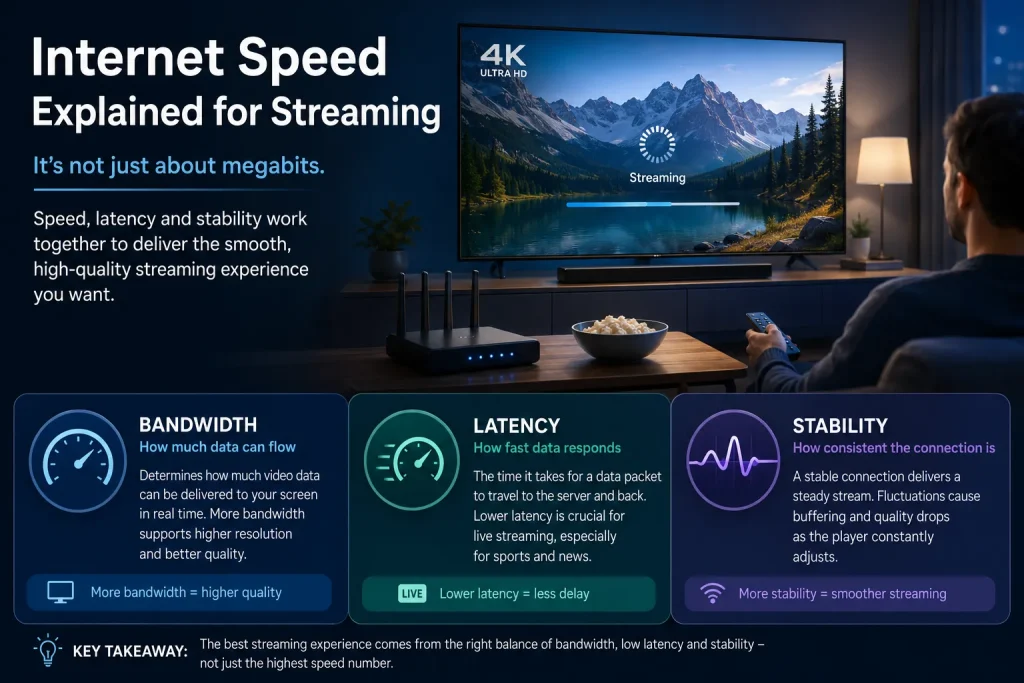
Internet speed is the single most important technical factor behind your TV streaming experience, yet it remains one of the least understood. Most Swedish households now have access to fast broadband, but fast does not always mean optimised for streaming – and the difference between a smooth, cinema-quality picture and a frustrating, pixelated mess often comes down to details that have nothing to do with how many megabits per second your provider advertises. This guide breaks down exactly how internet speed affects your streaming in 2026, what numbers actually matter and how to get the most out of your connection.
When your internet provider quotes a speed, they are referring to bandwidth – the maximum amount of data that can travel between the server and your device per second. For streaming, bandwidth determines how much video data can be delivered to your screen in real time. The higher the bandwidth, the more data can flow, and the higher the image quality your device can sustain.
But bandwidth is not the whole story. Latency – the time it takes for a data packet to travel from a server to your device and back – matters enormously for live streaming. A connection with high bandwidth but high latency can cause delays and buffering in live broadcasts even when the speed looks impressive on paper. For on-demand content, latency is less critical, but for live sport and news it is one of the key variables that separates a good experience from a poor one.
Stability is the third dimension. A connection that fluctuates between 10 and 80 Mbit/s creates a worse streaming experience than one that holds steady at 25 Mbit/s, because the streaming platform’s adaptive systems constantly have to recalibrate. Consistency matters more than peak performance.
Different streaming quality levels have different bandwidth requirements, and understanding these thresholds helps you match your expectations to your actual connection.
For standard definition streaming, 3 to 5 Mbit/s is sufficient. The picture is watchable but lacks sharpness on anything larger than a tablet screen. Full HD at 1080p requires a stable connection of 15 to 25 Mbit/s, which is comfortably within reach for most Swedish broadband subscriptions. This is the sweet spot for the majority of everyday streaming – sharp enough to look excellent on a 55-inch TV without placing excessive demands on your connection.
4K streaming with HDR pushes the requirements significantly higher. A stable 50 Mbit/s is the practical minimum, and 80 to 100 Mbit/s is recommended if multiple people in the household are streaming simultaneously. Sweden’s fibre infrastructure means that 4K streaming is increasingly realistic for a large share of the population, but the router, the WiFi setup and the device hardware all need to keep pace with the connection speed for the quality to actually reach the screen.
Most streaming activity relies almost entirely on download speed – the rate at which data travels from the server to your device. Upload speed, which measures the reverse flow, matters primarily for video calls and content creation. When evaluating your connection for streaming purposes, download speed is the number to focus on.
Swedish broadband subscriptions commonly advertise symmetric speeds, meaning the download and upload speeds are equal. While this is excellent for versatility, it does not change the practical streaming calculation. A 250 Mbit/s symmetric fibre connection is far more than sufficient for even the most demanding 4K multi-stream household scenario. The constraint, if any, is usually found elsewhere in the chain.
One of the most consistent sources of streaming problems in Swedish homes is the reliance on WiFi for devices that could easily be connected via a network cable. WiFi is convenient, but it introduces variability that a wired connection eliminates entirely.
In a modern apartment building, your router is competing with dozens of neighbouring networks operating on the same or adjacent frequency bands. Interference, signal attenuation through walls and the physical distance between your router and your streaming device all reduce the effective speed and stability of your WiFi connection. The advertised speed of your broadband subscription is measured at the router – what actually arrives at your smart-TV on the other side of the apartment can be considerably less.
A wired Ethernet connection bypasses all of these variables. If your TV, streaming stick or media player is in a fixed location, running a network cable from your router is the single most effective upgrade you can make to your streaming experience, at essentially zero cost beyond the cable itself. For mobile devices and tablets, this is obviously not an option, but for a living room TV it is straightforward.
Modern streaming platforms do not simply send a fixed quality stream and hope your connection keeps up. They use a technology called adaptive bitrate streaming, which continuously monitors your connection and adjusts the quality of the video in real time to match your available bandwidth.
In practice, this means the platform will automatically step down from Full HD to 720p if your connection drops, and step back up when it recovers. The transitions are usually seamless and invisible to the viewer. The system is designed to prioritize uninterrupted playback over maximum quality, which is the right trade-off for most viewing situations.
For live content, adaptive streaming works slightly differently because there is no buffer of future content to draw on. The platform must make quality decisions with less lead time, which is why live streams are generally the first to show quality degradation when a connection becomes unstable.
One of the most common causes of streaming problems in Swedish households is not slow internet but shared bandwidth. Every device connected to your network and actively using it takes a slice of your total available bandwidth. If two people are streaming in HD, a third is on a video call and a fourth is gaming online, the cumulative demand can exceed what a mid-tier broadband subscription comfortably handles.
The solution is either a faster subscription or a router that supports quality of service settings, allowing you to prioritize streaming traffic over less time-sensitive activities like background updates. Most modern routers offer this functionality, though it is rarely enabled by default. Checking and configuring your router’s QoS settings takes fifteen minutes and can make a noticeable difference in households with heavy simultaneous usage.
The quality of your streaming experience also depends on the platform you choose. A service with well-distributed server infrastructure, efficient video encoding and a robust adaptive streaming engine will perform better on a given connection than one without these technical foundations.
For Swedish users looking for a broad channel selection combined with reliable streaming performance, iptvsverige.com offers a platform built for the full range of devices and connection types common in Swedish homes.
Whether you are streaming live sport in HD on a 65-inch TV over a gigabit fibre connection or following a news channel on a tablet over a 4G mobile connection, the platform adapts to deliver a stable picture.
A service without binding contracts also lets you test performance on your own connection before making a longer commitment – which is always the most sensible approach when evaluating any new streaming platform.
There are several practical steps Swedish users can take to improve their streaming performance without changing their broadband subscription. The first is restarting the router regularly – routers accumulate small errors over time, and a weekly restart keeps the connection running at its best.
The second is checking for background processes on your devices. Automatic updates, cloud backups and other background tasks can consume significant bandwidth without any visible indication. Scheduling these for off-peak hours removes a common source of unexplained streaming degradation.
The third is evaluating your router’s placement. A router positioned in a cabinet, behind a TV or in a corner of the apartment delivers a significantly weaker WiFi signal than one placed in a central, elevated and open position. If replacing a wired connection is not possible, optimizing router placement is the next best option.
Finally, if you are on an older router that came with your broadband subscription several years ago, it may be the bottleneck rather than the subscription itself. Router hardware matters, and a modern WiFi 6 router can make a measurable difference in households with many connected devices.
A stable connection of at least 15 to 25 Mbit/s is recommended for Full HD streaming without interruptions.
Yes, a wired Ethernet connection is always more stable and consistent than WiFi for streaming devices in fixed locations.
A stable connection of at least 50 Mbit/s is required, with 80 to 100 Mbit/s recommended when multiple devices are streaming simultaneously.
Buffering is often caused by WiFi interference, shared bandwidth across devices or high latency rather than insufficient download speed.
Yes, especially for live streaming, where high latency can cause delays.
Yes, Ethernet, better router placement and less background usage can improve it.
Understanding how internet speed affects your streaming puts you in a much better position to troubleshoot problems, optimise your setup and choose the right service for your household. In 2026, most Swedish homes have more than enough raw bandwidth for excellent streaming – the real question is whether that bandwidth is being used effectively. With the right setup, the right platform and a connection that delivers stability as well as speed, there is no reason your streaming experience should be anything other than excellent.

I am Michael Bennett, a content writer who writes about digital entertainment, streaming platforms, and the latest technology. I enjoy sharing easy tips and helpful information for everyday users.
 English